Daman emerges as a quiet coastal gem where ancient ramparts meet gentle waves, drawing visitors into a tapestry of bygone eras and seaside calm. Nestled along India’s western shore, it promises a journey through sturdy stone defenses and elegant spires that whisper tales of distant conquerors .In our latest series of discovering destinations across Indian Daman is a less explored coastal getaway.
The Churches Of Daman
The Bom Jesus Church
The Bom Jesus Church in Daman stands as a beautiful reminder of Portugal’s long rule in India. Built during the early days of Portuguese control, it showcases their skill in blending faith, art, and power in everyday life.
Portuguese Arrival in Daman
Portuguese explorers first reached Daman’s shores around 1523 when a ship captain named Diogo De Melo sought shelter from a storm. They saw Daman’s spot on the Arabian Sea as perfect for trade routes linking Europe, India, and China, especially for spices and opium.
After years of battles with local Gujarat rulers, Portugal fully captured Daman on February 2, 1559, under Viceroy Constantino de Braganza. This marked the start of over 400 years of colonial rule, turning the area into a bustling port.
Building the Church
Right after taking control, the Portuguese began constructing the Church of Bom Jesus in 1559 in Moti Daman, the old fortified part of the town. It served as a simple parish church for the growing Christian community of settlers and converts.Work wrapped up with a grand consecration ceremony in 1603, making it one of Daman’s oldest surviving churches. Priests used it to spread their faith while the Portuguese built forts and homes nearby to protect their new outpost.
Architectural Highlights
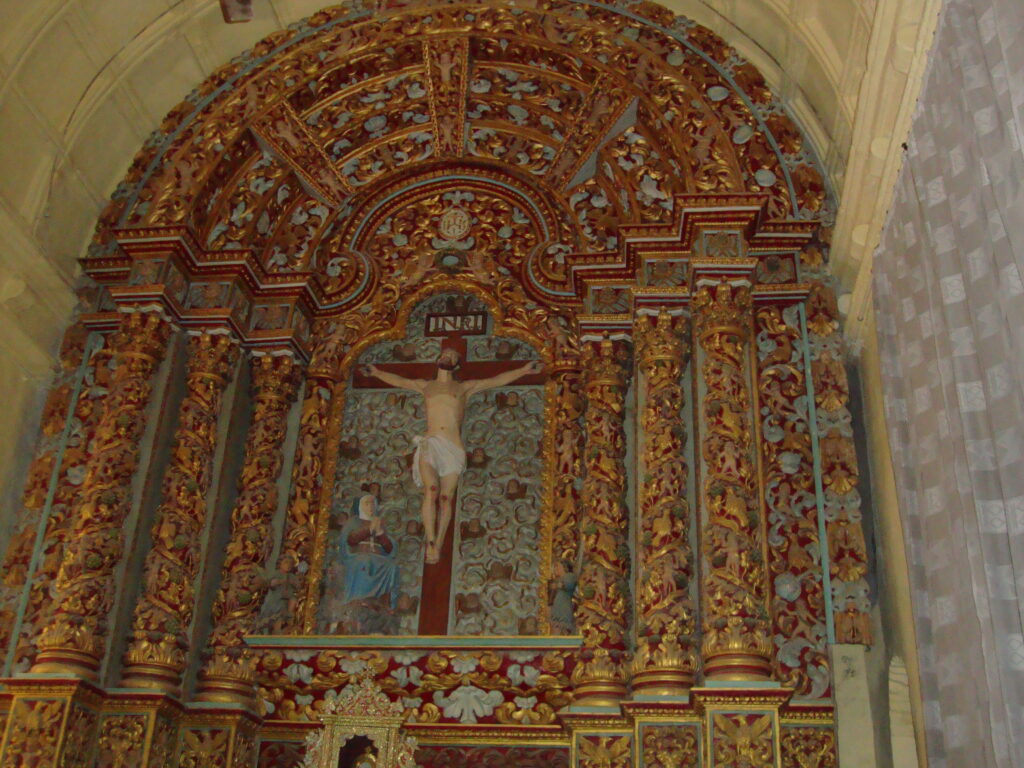
Imagine stepping into a space where every corner tells a story of skilled carpenters from Lisbon. The church mixes Roman and Portuguese styles with a tall white facade, carved wooden doors, and a gilded altar painted in gold that glows under light.Inside, lofty ceilings decorated with floral patterns lead your eyes up, while six statues of saints stand proudly along the walls. The pulpit and side altars, made from rosewood, feature swirling rococo designs—think fancy scrolls and flowers—that show off the artisans’ pride in their craft.
Role During Colonial Times
For locals and settlers, the church was more than a place to pray; it hosted weddings, baptisms, and community gatherings amid the hum of trade ships. From 1886 to 1928, it even acted as a cathedral with its own bishop overseeing Daman, Diu, and nearby areas.
The Portuguese held on tightly, using Daman as a key stop even after India gained freedom in 1947. The church witnessed quiet daily life under colonial flags until change came.
Liberation and Modern Days
In December 1961, India’s army launched Operation Vijay, swiftly freeing Daman from Portuguese hands after 450 years—ending on December 19 with their surrender. The church passed into Indian care, protected as a heritage site.Today, the Archaeological Survey of India maintains its wooden treasures, preventing decay from humidity. It draws pilgrims for the annual February feast with processions and lights, plus tourists admiring its peaceful vibe amid Daman’s beaches.
The Chapel of Rosario
The Church of Our Lady of the Rosary, often called the Chapel of Rosario, sits quietly inside the old Moti Daman Fort in Daman, India. Built by Portuguese settlers in the 17th century, it stands as a simple yet powerful reminder of colonial times and deep faith.
Local builders crafted the chapel sometime in the 1600s, using Gothic styles mixed with Portuguese flair for a plain outside but rich inside. It honors Mary of the Rosary, a saint Portuguese loved for protection in battles. The site was picked right against the fort wall for safety during threats from nearby Indian kingdoms.
A Statue’s Special Story
Legend says the chapel’s main statue of Mary came as thanks from a Portuguese leader who escaped a fierce attack by Maratha warrior Shivaji in the late 1600s. Shivaji’s forces raided Portuguese areas often, but this time, the commander credited the saint for his lucky getaway. They placed the statue on the altar to celebrate that miracle, making it the chapel’s heart.
Step inside, and the plain walls hide wonders: walls carved with Bible tales and saint lives, a ceiling like colorful rose petals with golden baby angels floating above. The altar shines with gilded wood, one of the finest from Portuguese India. Old gravestones of early settlers dot the square outside, whispering of lives from 400 years ago.
The chapel saw wars and sieges but survived, now protected by India’s Archaeological Survey as a heritage gem—often closed but opened for special visits. After Portugal left in 1961, locals kept its faith alive amid Daman’s mix of Hindu, Muslim, and Christian folks. Today, it draws history lovers to touch a piece of Europe’s adventure in India.